Hubs and shared mobility: planning and acting together
Published on February 10, 2026Getting started with hubs and shared mobility? You don't have to reinvent the wheel. Brainport Bereikbaar supports municipalities with knowledge, experience, and practical guidance. Project leaders Eline Swinkels and Pierre van Veggel explain how they help municipalities move from planning to implementation.
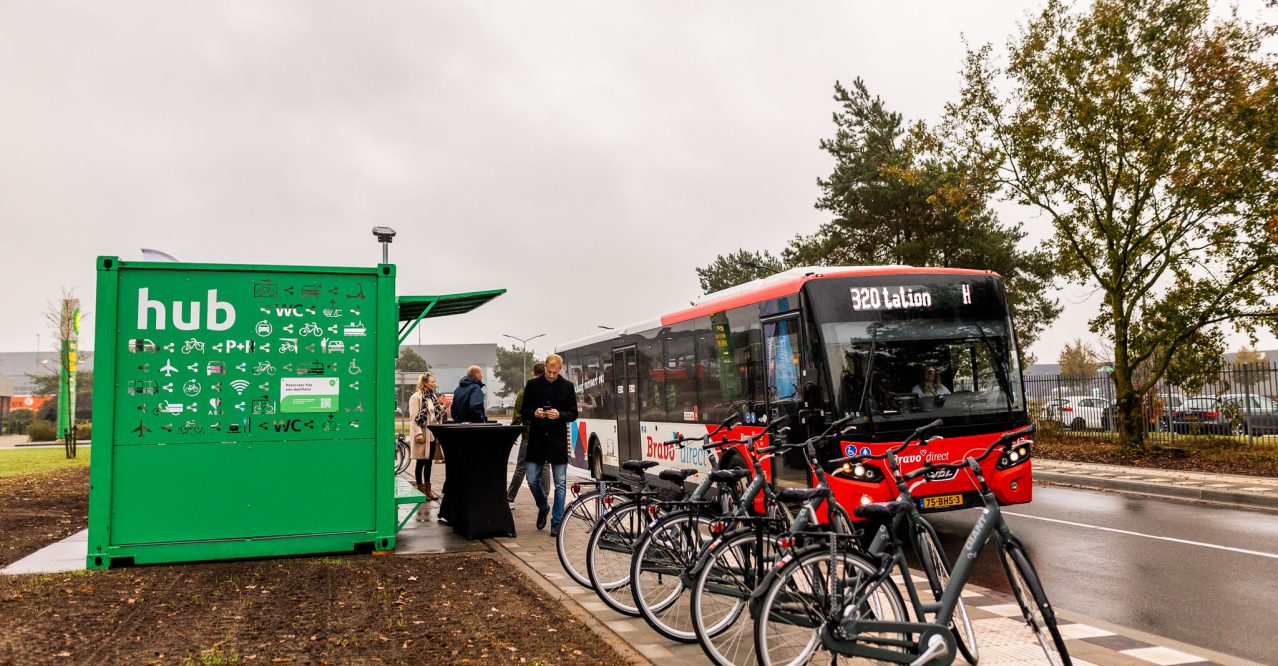
A hub in your community or neighborhood offers significant benefits. It doesn't have to involve large, expensive parking lots: a few additional amenities at the existing bus stop can make a big difference. "With a good bike rack, a few parking spaces, and a meeting point for Samenrijden (Riding Together), the stop along a direct bus route becomes much more attractive," says Pierre. And by adding car or bike sharing, residents create better alternatives to private cars, less pollution, less congestion on streets and parking spaces, and more space for greenery. "But: anyone who gets involved discovers that creating a hub involves a lot," adds Eline. "We help make it a success, whatever the phase."‘
It starts with the location
A key success factor is the hub's location. "It's not just about what's happening in your own community; the sum of all the hubs in the region, together with public transport, forms a network," Pierre explains. Eline: "The function of a hub is also important. Do you want to open up smaller communities, relieve congestion on a specific route, or better organize the last mile? That partly determines the location, but also what you want to organize there in terms of shared mobility, for example." Pierre: "The Hubs & Shared Mobility Development Plan contains a wealth of information. The potential of various locations for regional hubs has also been calculated to support this. The promising locations align well with our corridor- and area-based approach. Moreover, we have extensive data from employers in our region. Municipalities can benefit greatly from this knowledge."‘
From research to practice gardens
At the same time, Brainport Bereikbaar is accelerating implementation. Eline: "We don't build hubs ourselves. However, we do contribute to the overall plan. This is different for every municipality, depending on future plans, spatial developments, and desired amenities. We investigate which mobility solutions and what type of hub are needed, test what works and what doesn't, practice with various local shared mobility projects, measure effects, and provide insights. We even establish contacts with suitable shared mobility providers." Pierre: "Like a spider in the web, we also share the experiences of others and explore opportunities for collaboration."‘
Actions on the streets
Is the hub already completed? You can still contact Brainport Bereikbaar. Eline: "A hub is useless if there's nothing to do. We'll take action on the streets. Think about the layout and appearance of a hub, involving employers in the use of shared mobility at the hub, implementing public transport pilots, campaigns for residents, and even installing our pop-up hub or elevator columns for added visibility. Concrete products and actions, very hands-on." Pierre: "Of course, it's best to ask us when you're developing hubs. But we can certainly also help you a lot later in the process."‘
Make an appointment now!
Curious what this could mean for your municipality? View the options on the website of Brainport Accessible or take direct contact on.
Want to spar right away?
Email to eline.swinkels@brainportbereikbaar.nl or pierre.vanveggel@brainportbereikbaar.nl. We're happy to think and participate!
Get inspired!


Do you want to keep Brainport accessible? Join us. We would be happy to discuss this with you. To work on opportunities, innovations and solutions. Because we can only do that together. Contact us at info@brainportbereikbaar.nl.
 English (UK)
  Nederlands